
opening story
In the ancient Roman world, courtyard gardens brought cultivated greenery and useful plants into daily life, making a garden part of the home rather than a distant landscape. That long tradition of growing close to where people live continues in a different form on apartment balconies, where a few pots can bring fresh leaves and familiar flavors within reach of the kitchen.
Leafy greens and radishes make easy starting choices, while sunny balconies can also support compact tomatoes, peppers, peas, and bush beans. Cut-and-come-again harvesting means picking outer leaves while the plant’s center continues to grow. It lets a small patch keep offering food and flavor over time.

For apartment dwellers, a little space can turn a daily view into a useful source of fresh ingredients. A few well-chosen plants can bring crisp leaves to lunch and ripe fruit to dinner, without asking for a yard. A modest harvest can make an everyday meal feel newly connected to the place it grew.
Key Takeaways
- Start with leafy greens or radishes.
- Choose fruiting crops for sunny balconies.
- Pick outer leaves while the center grows.
- Grow plants that fit meals you already enjoy.
- A few pots can make a small space productive.
Best Vegetables for Balcony Garden: Match Crops to Sunlight
The first decision is not which seed packet looks tempting, but how many hours of direct sun the growing spot receives. Direct sun is the key measure, and the first thing to put in a garden is a clear picture of the light.
East-facing balconies commonly get 3 to 5 hours of direct morning sun, though nearby buildings can change that window. Herbs and leafy greens suit that light, but tomatoes and peppers need a brighter site.
| Light situation | Direct sun | Suitable crops |
|---|---|---|
| Warm-season crops | 6 to 8 hours | Tomatoes, peppers, eggplant, squash |
| Cool-season crops | 3 to 5 hours | Lettuce, spinach, Asian greens |
| East-facing balcony | Commonly 3 to 5 morning hours | Herbs and leafy greens, not tomatoes or peppers |

Full sun for fruiting crops
Tomatoes, peppers, eggplant, and squash are warm-season plants that need 6 to 8 hours of direct sun. That light helps fruiting plants grow and set crops. A balcony with less sun is a better home for greens than for a tomato vine.
Morning sun and shifting shade
Cool-season plants, including lettuce, spinach, and Asian greens, can grow with 3 to 5 hours of direct light. For a balcony garden indoors, leafy greens, herbs, and radishes can work in bright spaces, while fruiting crops need stronger direct light.
Count the hours of direct sun, not the hours when the balcony simply looks bright.
Light changes with the season and the angle of nearby buildings. Check the growing spot at different times before choosing plants. Treat nearby walls and railings as part of the light map, since their shadows move across the day.
Ten Vegetables That Earn Their Place in a Balcony Garden
A useful balcony shortlist favors compact plants, quick leaf or root harvests, and crops that make good use of vertical space. The five easiest vegetables to grow for many beginners are lettuce, spinach, radishes, bush beans, and compact cherry tomatoes; the best fit still depends on available light.
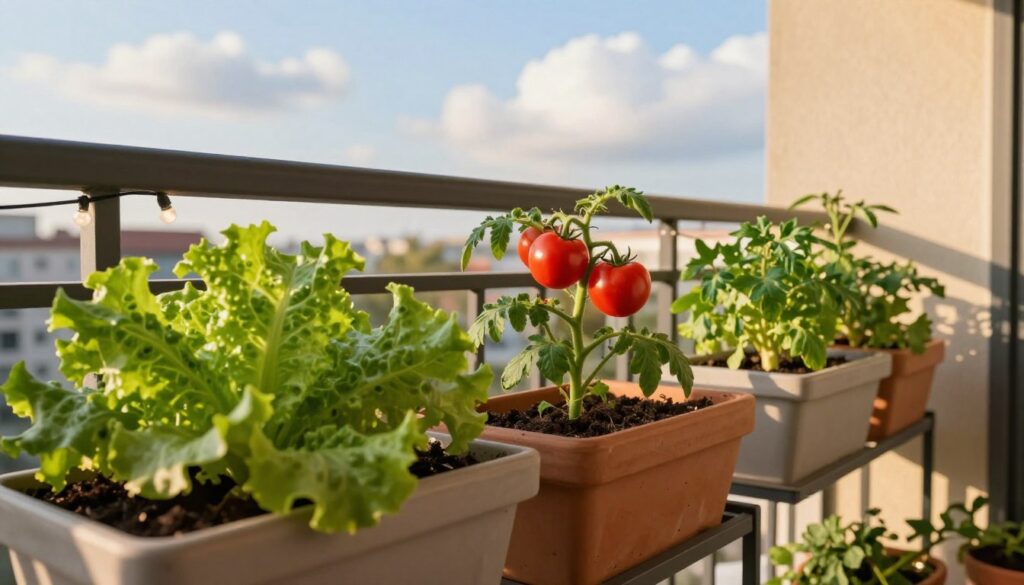
- Cherry or dwarf tomatoes offer compact plants with flavorful fruit.
- Peppers grow well in containers and produce useful kitchen staples.
- Lettuce offers leaves for repeat picking as the plant grows.
- Spinach provides tender leaves that suit repeated harvests.
- Radishes make a quick root crop for a small container.
- Bush beans grow in a compact form instead of climbing far.
- Carrots can grow as a small-root option in a suitable pot.
- Peas climb upward, making good use of a vertical support.
- Swiss chard provides leaves that can be harvested over time.
- Bunching onions supply fresh greens for soups and salads.
These easy vegetables grow well when their roots and light needs match their containers. A balcony crop guide can help compare varieties and growing habits before buying seeds.
Some familiar garden crops ask too much of a small container. Sweet corn, watermelon, winter squash, and zucchini are generally better choices for in-ground growing than balcony pots.
Seeds and young plants both work, so the choice can fit the grower’s time and patience. Start with vegetables that already have a place on the household menu.
Choose Containers and Potting Mix That Fit the Crop
Root room is a better guide to container choice than the pot’s appearance or its label. Compact crops such as peas, leaf lettuce, Swiss chard, peppers, and eggplant can grow well in pots, while the 70/30 rule is not one universal potting-mix standard.
Use the crop’s root depth to choose a container, then check that it has room for healthy growth. Containers should be at least as tall as they are wide, and ratios only make sense when the ingredients and purpose are clear.

| Crop | Container size guidance | Practical note |
|---|---|---|
| One tomato | At least 20 inches wide | Allow room for one plant |
| Peppers | 14 inches | Use a container suited to roots |
| Eggplant | 14 inches | Choose a pot at least as tall as wide |
| Swiss chard | 8 inches deep | Room for harvestable leaves |
Match pot dimensions to roots
Peas grow well in pots at least 6 inches deep, while leaf lettuce needs up to 6 inches of root depth. These smaller root needs can help make a narrow balcony planter useful.
A 70/30 gardening mix can mean different things, depending on what each part contains. For a soilless container mix, finished compost can make up as much as 50 percent.
Build a free-draining mix
Potting mix is made for containers, unlike ordinary garden soil, which can pack down in a pot. Each container needs drainage holes or slits so excess water can escape.
Rocks, gravel, and broken pot shards at the bottom do not improve drainage. They can raise the water table in the pot and increase the risk of waterlogging. Choose the container before sowing so the roots do not have to be disturbed during an avoidable upgrade.
Penn State Extension’s container guidance gives a 20-inch width for one tomato and a 14-inch pot for peppers or eggplants.
Water and Feed Containers Without Guesswork
A container needs more attentive moisture checks than a garden bed because its growing medium dries out faster. Check the potting mix regularly, since steady moisture helps keep roots from drying out without leaving them waterlogged.
Water until excess begins to drain from the bottom, then let the mix drain rather than keeping it soaked. Containers tend to dry faster than garden soil, so a quick check helps prevent dry roots between waterings.
Water to the drainage point
Press a finger into the potting mix to check its moisture before watering. A dry surface can hide damp soil below, so check the mix rather than relying on the balcony’s air or the pot’s weight alone.
Virginia Tech’s container watering guidance explains how potting media and container shape affect drainage and moisture. Its advice supports a thorough watering, followed by a check before watering again.
Feed through the season
Container plants need nutrients as they grow, and a two-part routine can make feeding easier to track. Add slow-release fertilizer when planting, then use soluble fertilizer every 2 to 4 weeks during the growing season.
Leafy greens and herbs can be useful low-maintenance balcony plants because they offer repeated harvests without sprawling vines. Yet every pot still needs moisture checks, and mint belongs in its own pot because it spreads rapidly.
Read the product label to match the amount to the container and crop. Check the fertilizer label again when changing from slow-release to soluble feeding.
Make a Small Balcony Work Harder
A balcony has more growing room than its floor suggests when rails, walls, and vertical supports are used thoughtfully. Vertical space can hold climbing crops and smaller pots without crowding the main walking area.
Try these ways to make a small garden more useful:
- Train peas up a trellis.
- Use tiered stands for smaller pots.
- Add railing planters for extra growing space.
- Secure wall or vertical planters in place.
Companion planting means growing certain plants near each other, but some pairings can work against growth. Onions and beans should not be interplanted because onions can stunt bean growth.
Keep plants with harmful companion relationships at least two to three rows apart where space allows. Results can vary by area, so a balcony grower can use separate containers for crops that should not share a bed.

High-rise balconies can be exposed to strong wind, which may stress plants and knock over unsecured items. A sheltered position can help protect plants, especially those on open rails.
For more ideas on planning a home growing space, consider the light, available room, and time for plant care together. Secure railing planters before filling them so a gust cannot dislodge a heavy pot.
Start Seeds and Harvest in Stages
A useful planting calendar follows local frost timing and crop preference, not a single nationwide start month. Local timing matters: cool-season crops can go in earlier, while warm-season vegetables belong outdoors after frost danger has passed.
Start cool-season vegetables in the local early-spring window, then plant warm-season crops after local frost danger has passed. The right month depends on the location and crop, not one date for every U.S. garden.
- Check local frost timing before choosing a planting date.
- Sow cool-season crops in a suitable spring or fall window.
- Plant warm-season crops outdoors after frost danger has passed.
- Sow quick crops such as radishes in small successive batches.
Radishes can be ready to harvest in as little as a month, depending on the variety. Small batches help spread the harvest instead of producing every root at once.
Lettuce also lends itself to staged picking. Harvesting outer leaves lets the center continue growing, extending the time the plant can provide leaves.
Keep each sowing date clear so different batches do not blur together. Mark each sowing date on its pot or seed packet to keep successive plantings distinct.
Check Balcony Safety Before Setting Pots
A pot that feels light when empty can become a substantial load once it holds moist mix and a mature plant. Moisture adds weight: a 20-inch-diameter container filled with moist potting mix and plants can weigh 100 pounds.
Check landlord or building rules before setting up balcony containers, and seek building guidance before adding large pots. A filled 20-inch container can weigh 100 pounds, so plan placement with care.
Check building guidance before loading a balcony with large containers.
Repurposed plastics rated #2 HDPE, #4 LDPE, and #5 PP are food-safe for edible crops. Avoid #3 PVC for vegetables.
A basic balcony vegetable garden kit can be simple: food-safe containers, potting mix, seeds, a watering can, and supports for climbing crops. Those items do not need to come as one packaged product.
For a first setup, carry an empty pot into position and fill it there instead of shifting it once it is wet.
Conclusion
A productive balcony begins with a few well-matched pots, not a crowded collection of every crop that sounds appealing. Good choices suit the available light and the meals the household enjoys.
A small first planting can provide useful leaves or fruit without taking over the balcony. Keep the first step manageable, and leave room to learn how each plant grows in that spot.
The best start is a crop that has a clear place in the kitchen and a season that fits local conditions. Choose one crop to eat regularly, then sow or plant it when local conditions suit its season.


