
Kratky Hydroponics for Beginners: Grow Food with Zero Electricity
Kratky Hydroponics for Beginners: How to Grow Fresh Food Without Electricity or Pumps.
Opening story
The Kratky method is a passive way to grow plants in nutrient solution without pumps or electricity. Dr. Bernard Kratky developed it at the University of Hawaii, and a small container can bring its practical appeal to a bright corner at home.
In 2021, a lettuce-growing study arranged a Kratky system on three levels, with 60 centimeters between them, in a footprint of 6 × 1 meters and a total height of 300 centimeters. The design offers a glimpse of a familiar human aim: making space for food where people live.
For home food growing, the method suits people who want fresh food at home without adding a powered hydroponic system. It can make small-space gardening feel more hands-on, while keeping the basic setup simple. For a first attempt, a single leafy green is a manageable way to see whether this style of growing suits the home.
Key Takeaways
How the Kratky Method Hydroponics for Beginners Works
A Kratky plant gets water and nutrients from the reservoir while the growing air gap gives another part of its roots access to oxygen. The air gap is the moist space that forms above the falling nutrient solution, where roots can access oxygen.
Kratky is a passive, non-circulating hydroponic method, so the system needs no water pump or electricity. A basic explanation of a hydroponic method also needs to account for how roots reach both solution and air.
Nutrient roots and air roots
Two root zones take on different jobs as the plant grows. Nutrient roots stay in the nutrient solution and take up water and nutrients.
Air roots remain moist above the solution and take in oxygen from the air gap. These names describe where the roots grow and what they do, not two separate kinds of plant.
That split lets the method supply oxygen without bubbling air through the water. A plant still depends on a suitable balance between the moist roots and the nutrient roots.
The falling solution level
As the plant uses water, the solution level falls and leaves more space between the surface and the lid. Roots in that newly exposed area can access oxygen while staying moist.
The level can remain steady for a time or decrease through the growing cycle. An at-home hydroponics guide also compares passive systems with pump-driven methods and explains their root zones.
The important rule is to let the solution level stay put or fall, not rise during the growing cycle.
Raising the solution can cover roots that developed above it. The plant’s access to oxygen depends on keeping that upper root zone exposed.
What Goes Into a Simple Kratky Setup?
A first setup needs only a vessel, a way to hold the plant above the solution, and the materials that support its early growth. A basic Kratky hydroponics kit should match the intended crop and container, rather than simply include a long list of parts.
The essential pieces are simple: a lightproof container, a net pot, growing medium, hydroponic nutrient solution, water, and a plant or seeds. A lid with a net pot can hold the plant above the reservoir without a pump or electricity.
Use this six-item inventory when gathering supplies:
Lightproof container
Net pot that fits the container lid
Growing medium, such as rockwool, clay pellets, or coco coir
Hydroponic nutrient solution
Water for mixing the solution
Plant or seeds suited to the setup
The container blocks light from the reservoir, and the net pot supports the plant above it. Growing medium steadies seeds or young roots inside the pot; it does not replace the nutrient solution.
Some beginner kits include a container, net pots, medium, and fertilizer, while others may not fit a chosen crop. Check that the parts work together and that the kit includes what the setup actually needs.
A seed-started crop and a transplant may need different support in the net pot. The container’s opening should hold the pot securely without letting it slip into the reservoir.

Choose the container and net pot together so the plant sits securely above its reservoir.
Reservoir Sizing and First-Fill Setup
For four lettuce plants, plan on 6-8 gallons of usable nutrient solution below the net pots. Commercial Kratky setups budget roughly 1.5-2 gallons per plant for a full season.
A reservoir that holds too little may run low before harvest, which can tempt a grower to raise the water level. Size the reservoir for the crop’s whole growing cycle and keep enough usable solution below the net pots.

Set up the reservoir in four steps:
- Estimate the season’s solution volume for the number and type of plants.
- Prepare nutrient solution by following the fertilizer directions.
- Place the transplant so the net pot’s bottom sits about ½ inch in the solution.
- Once the crop is growing, leave the level alone or let it fall.
Four lettuce plants need 6-8 gallons of usable solution below the net pots in this setup. The estimate helps prevent an undersized reservoir from forcing a mid-cycle change.
At transplant, the net pot’s bottom needs only about ½ inch of contact with the solution. That starting position gives the young plant access while its roots establish.
Later, roots may grow into the moist space above the solution. Adding more can cover roots that developed there, so the initial fill matters more than repeated adjustments.
Set the starting level carefully, because raising it later can submerge roots that have adapted to the air gap.
Light and Temperature at Home
A bright window or a suitable grow light can support an indoor crop, while a sunny outdoor spot brings changing weather and reservoir temperatures into play. The best position gives plants enough light without exposing the solution to unwanted heat.
Natural light can work when a window is bright enough for the chosen crop. Use a grow light when the indoor location cannot provide enough light, rather than expecting a dim corner to support steady growth.
Indoor light choices
A bright window offers daylight without extra equipment, but light levels change with the window’s direction and nearby shade. Watch how the plants grow and whether they stretch toward the glass.
A grow light gives a useful option when natural light falls short. Set the system where the light reaches the leaves evenly, and make sure the fixture suits the space.
Plants need enough light to grow, but the reservoir has a different concern: direct sun can warm its solution. An opaque container helps keep light away from the water and limits conditions that favor algae.
Outdoor exposure and reservoir heat
Outdoor placement brings sunlight and weather shifts together. Direct afternoon sun can warm the nutrient solution even when the plant seems comfortable.
In controlled lettuce trials, 25 °C maximized shoot and root dry weight, while 35 °C decreased growth. Those are results for that lettuce trial, not universal temperature targets for every crop.
Temperature changes can affect the reservoir as well as the leaves. Keep the reservoir out of direct afternoon sun if its solution is getting warm.
Five Hydroponic Systems Compared
Hydroponic systems differ in how they move nutrient solution and deliver oxygen to plant roots. Five common types are Deep Water Culture (DWC), Nutrient Film Technique (NFT), Kratky, ebb and flow, and aeroponics.
Each system pairs water delivery with a way for roots to get oxygen. Kratky stands out because it does not circulate solution with a pump, while other systems move or spray it.
How five systems move nutrient solution
The table compares these systems by solution movement and root access to oxygen. It shows common designs, not every possible variation.
| System | How nutrient solution moves | How roots access oxygen |
|---|---|---|
| Deep Water Culture (DWC) | Roots sit in oxygenated water | Oxygen is added to the water |
| Nutrient Film Technique (NFT) | A shallow stream moves through sloped channels | Some roots stay exposed to air |
| Kratky | Solution remains in a non-circulating reservoir | Roots reach air above the solution |
| Ebb and flow | A tray floods and drains at intervals | Roots access air between floods |
| Aeroponics | Nutrient solution reaches bare roots as mist | Bare roots are exposed to air |
DWC keeps roots in oxygenated water, while Kratky leaves part of the root zone above a static solution. Ebb and flow cycles the tray, and aeroponics delivers a mist to roots.
NFT flow and channel dimensions
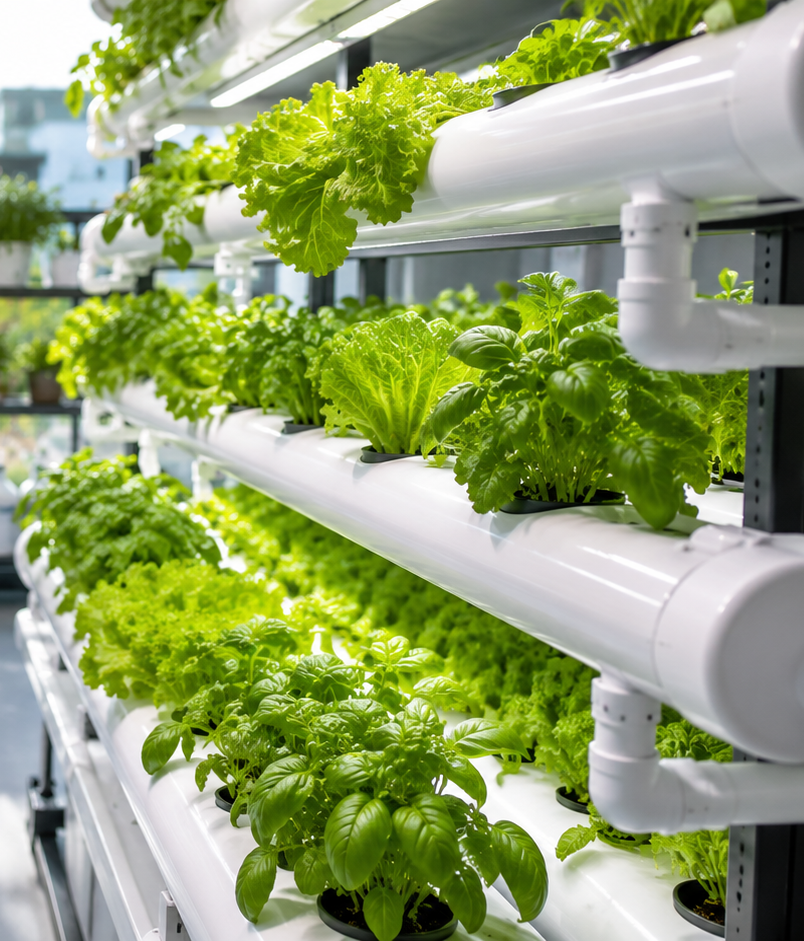
NFT hydroponics moves a shallow film of solution along a sloped channel. Its flow differs from static-solution Kratky, where no pump sends water through channels.
Common NFT channels use a 1:30 to 1:40 slope, with a nutrient film about 1-3 millimeters deep. Those dimensions let the stream pass along the channel while some roots remain exposed to air.
A common lettuce and spinach baseline is 1-2 liters per minute per channel. Smaller or delicate plants may suit a lower flow, such as 0.5 liters per minute.
Flow depends on the channel and crop, so a rate for NFT does not apply to every hydroponic system. A University of Hawaii digest on non-circulating hydroponics describes a passive system without mechanical aeration or circulation.
NFT flow figures are channel-specific guidance, not settings for a non-circulating Kratky reservoir.
Crops That Suit Kratky Best
Lettuce and herbs are straightforward starting crops because they suit the small, simple scale many beginners want to try. Leafy greens give a first setup a clear purpose without the larger demands of many fruiting plants.
Lettuce, spinach, kale, basil, and mint can all grow with this method. They make more approachable first crops than tomatoes, peppers, or cucumbers, which need more capacity and closer nutrient management.

Leafy greens and herbs
Lettuce offers a familiar first crop, while spinach and kale give growers other leafy greens to try. Basil and mint add herbs that can bring fresh flavor close to the kitchen.
These examples fit the modest scale of a basic container better than crops that grow larger or bear fruit. For outdoor container options, small-balcony vegetables can help gardeners think about crops in limited space, though that guide covers soil-based growing.
Choose a crop based on the room available for its growth, not only the size of its seedling. A small start does not mean every plant will remain small through harvest.
Fruiting crops need more planning
Tomatoes, peppers, and cucumbers can grow with the Kratky method, but they may need larger containers. Their nutrient management also calls for closer attention than a simple leafy crop.
A larger plant can use more solution as it grows, and a fruiting crop may bring a longer or more demanding cycle. That makes the small-reservoir approach less forgiving than it is for greens.
Start with a leafy green before committing to the larger reservoir and management demands of a fruiting crop.
Mixing and Monitoring Nutrient Solution
A nutrient mix should be prepared for the chosen crop and measured according to the fertilizer’s directions. Water quality matters because the minerals already in the water affect the starting solution.
Follow the fertilizer label for the amount and mixing method, then use measurements to understand the mix. EC and TDS show dissolved nutrient strength, but do not replace fertilizer directions.

Mixing a crop-appropriate solution
Different crops may need different nutrient mixes, so choose directions that fit the plant being grown. Mix the solution thoroughly before taking readings, since an uneven mix can give a misleading result.
A general pH range for hydroponic nutrient solution is around 5.5-6.5. A pH pen or strips can help track whether the solution sits in that range.
Reading pH and nutrient strength
pH describes how acidic or alkaline the solution is. EC, or electrical conductivity, and TDS, or total dissolved solids, are different indicators of dissolved material.
| Measurement | What it indicates | Common tool |
|---|---|---|
| pH | How acidic or alkaline the solution is | pH pen or strips |
| EC | Dissolved nutrient strength through conductivity | EC meter |
| TDS | Estimated dissolved solids in the solution | TDS meter |
Use this four-point checklist while preparing a fresh mix:
- Follow the fertilizer directions for the chosen crop.
- Mix the solution thoroughly before measuring it.
- Check the pH with a pen or strips.
- Record the readings so changes are easy to notice.
pH checks become more useful as a grower learns how local water and a chosen fertilizer behave together. Check pH daily while learning how the chosen water and nutrient mix behave together.
Algae, Mosquitoes, and Root Problems
A green film or insect activity is a reason to inspect the reservoir rather than assume the crop is thriving unattended. Passive does not mean problem-free: algae, mosquitoes, and root trouble can still occur.
Algae points to light reaching the nutrient solution, while mosquitoes can gather around uncovered stagnant water. A lightproof container helps prevent algae growth, but the lid and openings still need attention.

Keeping algae out of the reservoir
Look for light leaks around the lid, net-pot openings, and container seams if a green film appears. Blocking those paths helps keep light from reaching the solution.
Algae growth can change the look of the reservoir, but appearance alone does not show whether roots are healthy. Inspect the roots and solution rather than assuming the plant is fine or failing.
Managing mosquitoes and root trouble
Mosquito activity can occur near still nutrient solution when water remains uncovered. Check the lid and net-pot openings, especially if insects gather around the system.
Regular checks help catch changes before they are easy to miss. Look at the roots and reservoir together, since both can reveal a problem developing inside the container.
Check the lid and openings whenever insects appear around still nutrient solution.
What a Larger Kratky Lettuce System Can Show
A 2021 low-tech lettuce system shows that Kratky can be designed beyond a single container, though its results describe that particular setup. The unit grew 60 lettuce plants without water pumps or electricity.
Its reported financial measures describe one design and its costs, not a typical home garden. The figures should not be treated as a forecast for another grower.
A 60-plant lettuce unit
A 60-plant system is a study-specific example of a larger application, not a suggested household scale. Its no-pump design shows how a passive system can serve more than one small container.
The result depends on that unit’s design and growing conditions. A household setup will not share every cost, crop volume, or operating detail.
Reading the reported economics
The study reported a net present value of $16.37 and an internal rate of return of 12.57%. Its non-discounted payback period was about eight months, or four cropping seasons.
|
Measure |
Reported result |
What the measure represents |
|---|---|---|
|
Net present value |
$16.37 |
Value of projected cash flows in present terms |
|
Internal rate of return |
12.57% |
Rate at which projected net present value reaches zero |
|
Non-discounted payback period |
About 8 months, or 4 cropping seasons |
Time to recover the initial investment without discounting |
These measures describe the economics of the studied lettuce unit, not a household outcome. Costs, yields, and growing routines can differ across systems.
Treat the study’s figures as a case example, not a promise of returns from a home garden.
Harvest and End-of-Cycle Care
At harvest, the reservoir marks the end of that crop’s nutrient-solution cycle. Check what remains before deciding how to prepare the container for another run.
One commercial lettuce-growing account found its nutrient solution nearly depleted by harvest. Its tanks were sprayed down and vacuumed after 3-5 cycles, though cleaning timing depends on the system and growing routine.
Use these four end-of-cycle steps:
- Harvest the mature crop.
- Inspect how much nutrient solution remains.
- Clean the reservoir between crop runs when needed.
- For the multi-cycle practice described, spray down and vacuum tanks after 3-5 cycles.

Cleaning timing depends on the system and growing routine, not a universal timer.
Before planting again, make sure the container is clean and ready for a fresh crop.
Conclusion
A small first crop can make the unfamiliar parts of soilless growing easier to observe. A manageable scale gives a new grower room to learn without committing a large space or supply of food.
Choose a crop that fits the light and room available, then watch its changes during the first week. Begin with one leafy-green plant in a reliably bright spot and note how it grows during its first week.


